Yesterday, I told one of my students that I got tested for STIs last week.
He laughed.
Soon realizing that I was not in on the joke he stopped immediately, asking "sexual diseases, ne [right]?" Yes, I intoned, almost challenging him to ask why. We were previously talking about his recent health checkup so contextually I shared my recent visit to a clinic. He commented that I look healthy, which I told him is a major reason why people unwittingly spread diseases- the assumption of being able to spot someone with a sexually transmitted infection. Someone who isn't "clean," as they have unfairly been called. And while I thank him for the compliment, I owe being healthy to being aware that every sexual experience I have is one more possibility for contracting an infection, or the worst disease of all- pregnancy.
Now that I can take advantage of Japan's socialized health care, I immediately began with a battery of tests. After two bus transfers, I made my way back to the public health clinic, Hamamatsu Hokenjo, to get the results of the blood tests I took last week. Silently, I prayed that the needles are more sterile than the building they are housed in. This building has all the charm of Earl K. Long Hospital in Baton Rouge, but none of the inefficiency. Within minutes of arriving, my number was called and I was led into the same room where I previously answered a few questions like:
"Do you have a reason to believe you have recently contracted HIV/AIDS?" (No)
"Have you ever been treated for Syphilis or Chlamydia before?" (No)
"Do you routinely share needles with other people" (Um... well, not since 'Nam)
In Japan, if you take an anonymous blood test it is not customary for the result to be handed to you on paper or given over the phone. You have to come in-person and give your initials. "Ohaiyo gozaimasu" I greeted the nurse and told her immediately that I cannot speak Japanese. She said "Daijoubu [it's okay], I speak little English" before continuing in Japanese. Like the statement "guilty until proven innocent," I apparently understood Japanese until I pulled a strange face. She spoke, and I listened carefully for her intonation. If something sounded serious or if she asked a question that I didn't understand, I raised an eyebrow. She then translated the last word of her sentence, "Blah blah blah... paper." But she was very kind and patient, so I do not intend to make light of her effort to help me understand the results. All I needed to hear anyway was negative.
Finally, after searching for my results, she pointed to negative for all four tests and instantly became my new best friend (well, my new best Japanese friend... not that there's much competition). She continued to talk and I continued to say "Hai" until she made small talk. She asked me the typical question: "When do you come to Japan" (which, as an English teacher, I usually correct but this was not the time) and, in Japanese, asked me if I either eat or like Japanese food. I don't know which one but the answer is yes for both, so I said so. I thanked her and made my way back home to sit in my STI-free skin and thank all those in my life who champion safety.
My student is a good representative of many people I know, in America and abroad: people who believe testing for STIs is relegated for sex workers and homosexuals (and, you know, bisexuals). It is unfortunate that this ignorance spreads, like, well...legs. Everyone who is sexually active should be aware of their status regarding STIs and it should be regarded as routine as an annual physical. I honestly went into the office confident that I would once again receive favorable results (I almost typed positive results, but that would be assuredly antithetical) but leaving always produces a little healthy anxiety.
The best part about waiting a week for your results is reevaluating the sexual transgressions of the past. But getting tested isn't about regrets and the fear of sex. The absolute best part of getting those results is looking forward to the sexual adventures of the future and knowing that you have more time to play the game.
So play on.
13 September, 2009

03 September, 2009
Podium
In 24 hours, I will officially join what is thought by many to be "socialized health care." I will walk into a Hamamatsu ward office and leave with an insurance card. This card means doctors would only charge me 30% for any health care I need outside of the meager insurance provided by my company (which I was told at the ward office is traveler's insurance). So when I go to the dentist, a much needed trip, I will be responsible for paying 30% of the procedure and any prescriptions. It's the first time since I've been a working American male that I've had my own health insurance, and it is a shame that I could not get a similar option in America.
The landmark study "Care Without Coverage: Too Little, Too Late," has been widely quoted in the midst of the health care debate in America. This 193-page report has been so important because it points out that 30 million (that's one in seven) working-age Americans cannot get insurance from their employer or are too young for Medicare; approximately 10 million children lack insurance altogether. The fact that 18,314 people die in the USA each year should be a sobering one for the country that outspends the rest of the world in health care but provides only a fraction of the population with adequate health care.
For many Americans, the idea of not having health insurance is unfathomable. Some people have been fortunate to not know what it is like to lack coverage. However, this American has never had his own health insurance plan and is now officially too old to be covered under his mother's health insurance. In America, I would be between a rock and a hard place should something happen to me. Even when I was partially covered under my mother's plan, I had to pay a considerable amount for health care. It was generally enough that I usually avoided hospitals and dentists. That avoidance could have prevented my health, particularly my teeth, from declining. I know several people who refuse to call an ambulance because the cost of having one come to pick you up, even in an emergency, is not covered in their insurance, if they are in fact covered at the time of illness. Personally, I had to open a credit card to pay for previous dental work that I am still trying to pay for two years later, because the interest rate is sky high. If I were in America working the exact same job, I would not currently have any options to consider about my health care.
I do not say this lightly: thankfully, I am not in America.
I am in Japan, a country with socialized health care insurance and the world's highest life-expectancy rate. To be clear, about 80% of Japanese hospitals are privately owned, so it is not "socialized medicine," as NPR clarifies in an April article on the health care situation of Japan. Japan has what many Americans are fighting for now, universal health care. Specifically, a Public Option. Simply put, I can opt for National Health Insurance. Japan requires health care for everyone, but I can choose from three different programs:
1) Shakai Kenkou Hoken (Company-Provided Insurance)- Your company will provide you with this insurance if you are currently working full-time. Your deductible will come directly out of your paycheck and is a certain percentage of your earnings and will cover up to 70% of your medical bills. (Now the kicker is that full-time means 30 hours a week, I am reportedly working 29.5 and not full-time which makes me ineligible for this option.)
2) Kokumin Kenkou Hoken (National Health Insurance)- Opting into this plan means the government pays 70% of your treatment, while you pay the other 30%. This is the plan most students, unemployed and self-employed people have. The government sends you a bill every month like an insurance company but the amount you pay is based on residence tax, dependents and property owned.(This is the option I will have to choose)
3) Private Health Care- like America, you can choose your own personal health care option which gives you the coverage that you prefer at the costs you prefer. This option, for those who can afford it, usually means full-coverage, or at least more than 70% (which honestly isn't bad to begin with!)
In fact, the only people really complaining about Japanese health care are physicians. Japanese health care has limits on how much doctors can charge for operations and procedures. This is standardized across the country. While in America one doctor can charge an arm and a leg for an X-ray, the cost of imaging is the same all over Japan, and relatively cheaper.
Japanese people live longer than Americans because of diet as well as preventive care. They see a doctor three times as much as Americans according to T.R. Reid with NPR. And they see any doctor they want. Of course no health care plan is perfect, but the fact that I have choices, "options open to the public" if you will.
See, the thing people seem to be confused about is that the Public Option that the President is seeking is no different at all from the one already in place here in Japan and other intelligent developed countries. England's universal health care program began in 1911, but really expanded into the modern form in 1946 after the blitz of World War II. And England has learned that it's program isn't perfect and is currently seeking ways to reform it to improve hospitals and wait times. But at least it has a system in place to insure everyone has access to care. And no one in Japan has to declare bankruptcy because of unexpected hospital bills. It is a kick in the face that once a doctor saves your life you don't have much to life for when the bills pile up. Having a Public Option means I can choose to have private insurance or choose the government to assist me when I need health care. Knowing the government has a safety net for me makes me feel like an actual human being.
Which makes me afraid to figure out what will I be if I have to go back to the states and lose any coverage.
I'll continue to post about my journey through the scary path that is socialized health care.
Ikuzo.
05 August, 2009
Gundamn!
I am a nerd in fashionable clothing.
I don't come right out and say it, but I used to be hooked on Japanese animation. Loved it. From Thundercats to Voltron, Sailor Moon to Rurouni Kenshin. I watched it all and pretty much loved it all, especially Gundam Wing. Well, Gundam (large fighter robots piloted by humans) have been around in Japan for 50 years, and to celebrate their longevity, Tokyo has decided to build the first life-size Gundam in Odaiba Park this year, for one month only. So, I really picked the best time to live in Japan.
Here are a few pics of the awesomeness that is a life-sized Gundam.


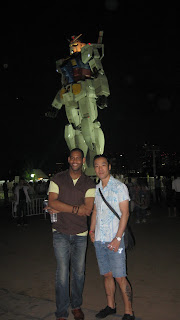
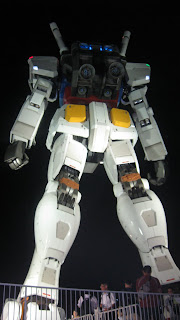

I don't come right out and say it, but I used to be hooked on Japanese animation. Loved it. From Thundercats to Voltron, Sailor Moon to Rurouni Kenshin. I watched it all and pretty much loved it all, especially Gundam Wing. Well, Gundam (large fighter robots piloted by humans) have been around in Japan for 50 years, and to celebrate their longevity, Tokyo has decided to build the first life-size Gundam in Odaiba Park this year, for one month only. So, I really picked the best time to live in Japan.
Here are a few pics of the awesomeness that is a life-sized Gundam.


02 June, 2009
Tokyo ni ikimasu!
Greetings, ether.
I finally decided to put fate into my own hands and stop waiting for something incredible to happen. I decided that I am tired of not having anything exciting to write about, so I made a plan to spend the month of June, my birthmonth, doing the things that I really want to do.
Of course I still have the obligation of doing my job, but on the weekends, I will be watching loads of theatre- the biggest reason I came to Japan. This upcoming weekend, I will begin in the best way possible: my first trip to Tokyo.
I'll get there close to midnight after Saturday's work to meet up with my new friend and Tokyo tourguide. He's already got our tickets to see a kabuki rendition of Shakespeare's Twelfth Night, directed by one of Japan's most famous current directors: Ninagawa-san. But that's on Monday. On Sunday, we will be shopping all over Shibuya, heading to Ginza, and maybe Roppongi so I can finally buy some boots. Japanese feet are typically smaller than American, so the sizes don't come anywhere near 13 (30cm) in most shops. But the gaijin (foreigner) district of Tokyo, Roppongi, may have something for me. I hope so, because Japanese boots are so fierce, they might as well be labeled WMDs.
Pictures and updates to come.
And I still have to tell you about South Korea.
I'm so bad at keeping this thing updated. What the hell happened to me?
04 May, 2009
South Korea, backtracking
I'm gonna come clean with you:
This is written in the future about a trip that I took at the end of April-beginning of May.
I went to South Korea and had a terrific time just connecting with people. I didn't want to explore, I just wanted to have something I had been missing dearly in Japan:
Normal conversations with old friends.
Surprisingly, I managed to spend a week with five people from Baton Rouge who now live in Asia (Korea and Japan). It was splendid. Here are some pics to get you through the hard times. Kidding.


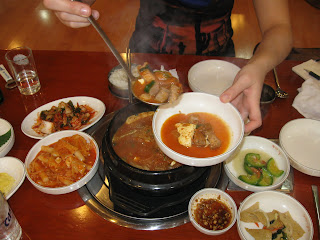
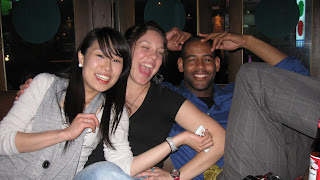
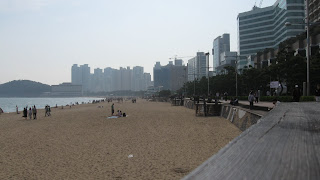
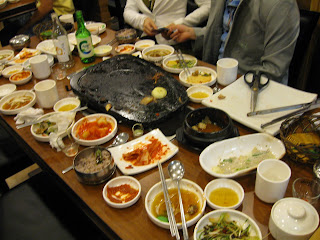
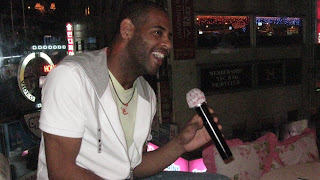

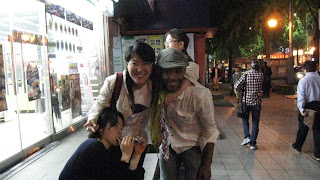

This is written in the future about a trip that I took at the end of April-beginning of May.
I went to South Korea and had a terrific time just connecting with people. I didn't want to explore, I just wanted to have something I had been missing dearly in Japan:
Normal conversations with old friends.
Surprisingly, I managed to spend a week with five people from Baton Rouge who now live in Asia (Korea and Japan). It was splendid. Here are some pics to get you through the hard times. Kidding.


03 May, 2009
Ode to being the nice guy
Everyone Else
And yet
And yet everyone else gets what they want.
I'll see to it
I'll see to it that everyone else gets what they want
I'll see to it, and yet
I cannot see what I want.
What is it that I want?
Maybe these five years back.
Five years is a long time
Five years is a long time to see that everyone else gets what they want and yet
I still cannot see the point
The point
The point where everything feels home
And everyone else feels like home
And yet I am writing from your bed, alone
You made your bed
You made your bed now I lie in it
And yet
And yet being home is the only time where things make sense
Because I can sense through blue eyes
This is the last sleepover because of everyone else
And yet I can see the paths ahead of me and everyone else
The paths are made of dust and clay that forms
Clay that forms from
The clay is made of vermilion dust, two parts dust one part tears
Tears from blue eyes
Not shed over you
Not over you yet (not over you, yet)
A record to chant, a mantra on repeat
These tears are not shed over your skin
I can shed your skin
And yet
And yet the red dust is comprised of human skin
So dust is a reminder of everyone else
And yet everyone else gets what they want, and with green eyes I'll see to it that everyone else
And yet
And yet everyone else gets what they want.
I'll see to it
I'll see to it that everyone else gets what they want
I'll see to it, and yet
I cannot see what I want.
What is it that I want?
Maybe these five years back.
Five years is a long time
Five years is a long time to see that everyone else gets what they want and yet
I still cannot see the point
The point
The point where everything feels home
And everyone else feels like home
And yet I am writing from your bed, alone
You made your bed
You made your bed now I lie in it
And yet
And yet being home is the only time where things make sense
Because I can sense through blue eyes
This is the last sleepover because of everyone else
And yet I can see the paths ahead of me and everyone else
The paths are made of dust and clay that forms
Clay that forms from
The clay is made of vermilion dust, two parts dust one part tears
Tears from blue eyes
Not shed over you
Not over you yet (not over you, yet)
A record to chant, a mantra on repeat
These tears are not shed over your skin
I can shed your skin
And yet
And yet the red dust is comprised of human skin
So dust is a reminder of everyone else
And yet everyone else gets what they want, and with green eyes I'll see to it that everyone else
27 April, 2009
Absence
Apologies on the lengthy absence. I'll make it up with a lengthy account covering the many things floating in my head that need a landing pad and pen.
Unfortunately, my lack of writing is not due to leading an exciting, adventurous life. Actually, it is because I really have not accomplished much. I spend almost ten hours a day at work and when I come home around 10:30, all I want to do is eat, catch up on facebook, and study Japanese.
I seriously study about 2-3 hours every night and while I can start to see some improvements, like my reading speed is picking up, I am still so far behind where I would like to be. But, I am more determined than frustrated. I mean, look at how many years of French I took in school, including college, and I probably have the same mastery of the language as a French middle-school student. So if my Nintendo DS Japanese Coach says I am a Japanese First Grader, well then I'll accept it as a sign of improvement. At least I can ask where is the restroom without needing help.
Toire wa doko desu ka.
Anyway, Japanese people always ask me "How is Hamamatsu life" or "How is Japan life." It is an interesting question for two reasons: first, the proper way to translate that question into colloquial English is "How do you like living in Hamamatsu/Japan?" but I think it is fascinating because my mind starts to dissect how I think people in Hamamatsu/Japan live in comparison to American life.
Last night I invited Keiji, one of my students, over for drinks. After a few beers, wine and sake, we (including his friend) were discussing societal differences. Many of these I've thought about on my own, but it is completely different to hear Japanese men discuss these. For example, we talked about how Americans are free to discuss their opinions in class. Of course having the correct answer is important, but so is being able to formulate an answer through your own mental processes, of your own volition.
Japanese students are forced to just memorize through rote learning. Unless you know the correct answer, you do not speak. It is frustrating as a teacher of the conversational use of English to have students who will not speak. But I do my best to not only remind them that there is no penalty for the wrong answer but better: a reward in the form of mastery. The only way we can really learn a language is to try speaking it. Really. We learn through trial and error and my students who show the best improvement are the ones who volunteer first and who suffer through my polite corrections. And class is better because of their courageous offerings.
In my opinion, I think a system that combines both is what's really needed. Of course Americans are free to discuss opinions in class, but the majority of 20 somethings in America cannot accurately find Afghanistan on a map, even though they may have a strong opinion on whether troops should be sent there or not. Also Americans are infamously the loudest tourists in the world, because we are encouraged to be expressive. I do think there are times when it is vital to speak out. I also think there is a time to shut the hell up. And this is where Japan and America should educate each other.
I am slowly becoming a better teacher, definitely a more patient person, and because I am learning Japanese while my students are improving their English I always remind them how proud I am of their work. Because when they say their English I poor, I show them how bad my Japanese is. This proves to them that they really are not as atrocious as they think!
Last night, Keiji's friend commented on my hospitality. As they emptied their glasses I always made sure there was another full one waiting and I kept them entertained. He joked in Japanese, only to translate it later, that I am more Japanese than American. What a compliment. But I am very glad that I was born in such a country that allows me to explore my own personality and desires (with limitations that vary from city to city of course).
I didn't learn how to be a good host in Japan. It's something that I worked on in America; something that Louisiana in particular encouraged. And while I never want to move back to Louisiana, I am proud to be able to share the sense of southern hospitality- the finer points of my heritage that one can glean from such a closed-minded place.
On the 29th, I am taking my first trip away from Japan. It funny that I've lived here for three months, yet I will have explored South Korea more extensively than my own country. But once I get a firm grasp on my job, I will start to venture out to Tokyo, and to the lands past my favorite city, Nagoya, including Osaka, Kyoto, Kobe, and the like. Maybe I'll go up to Hokkaido, have a Sapporo in Sapporo. Or travel to Okinawa and eat Spam. I hear they do marvelous things with canned ham-like products there. But during my week-long vacation I am going to do just that: vacate.
I promise the cornucopia of pictures will overwhelm and you will welcome another lengthy absence. And when I come back, I am finally going to mail all of the wonderful things I've collected for my dear family and friends. Because you deserve to know how much I actually think about you even though we're miles apart.
Subscribe to:
Posts (Atom)